 Bona Fide
 SIE EXAM STUDY GUIDE
How to study Products and Risks for the SIE exam
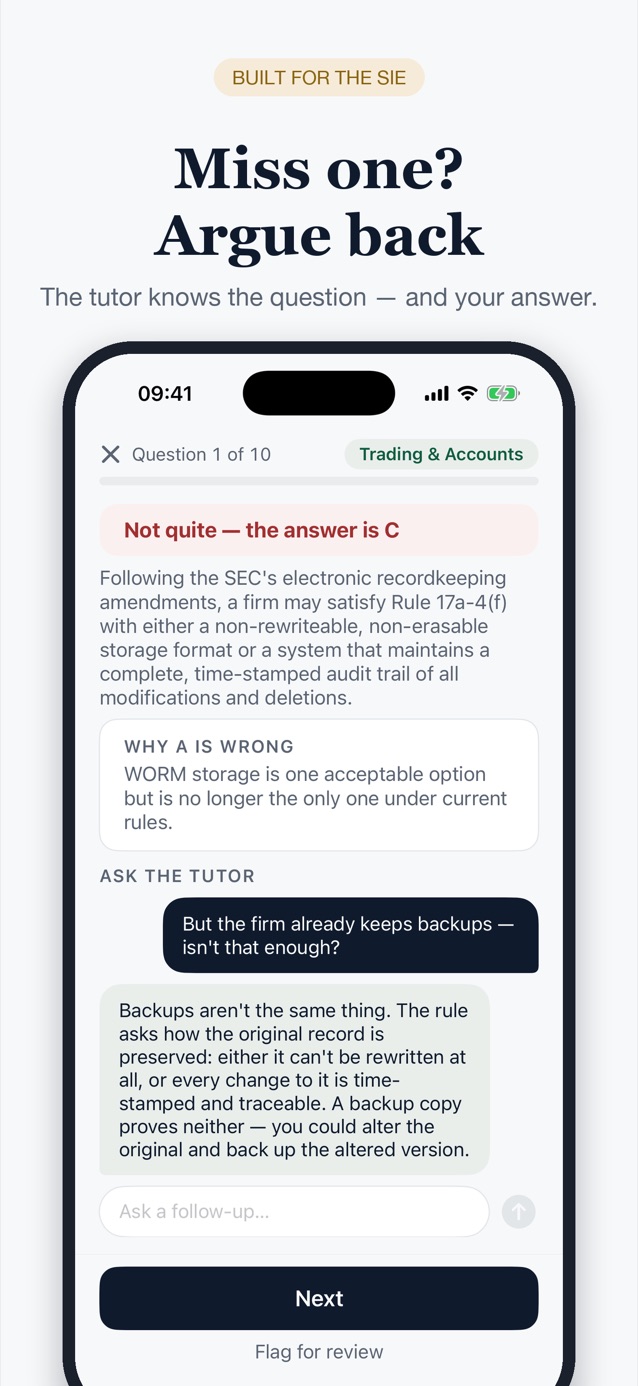
Bona Fide helps you see whether Products and Risks needs more work by showing your SIE readiness by domain. Practise questions on iPhone or iPad, review explanations for the choices you missed and ask the tutor about the exact question when you need another explanation. Unlimited questions and tutor access require Pro.

Products and Risks is 44% of the SIE, so it is usually the best place to spend extra study time. Learn each product by comparing its features, investor fit, tax treatment, liquidity and risk. Then practice choosing between similar concepts in question form.
Study comparisons instead of isolated definitions
A definition alone is rarely enough. Put securities side by side: common stock and preferred stock, open-end funds and closed-end funds, bonds and bond funds. Ask what changes when rates move, who carries risk, and how an investor can sell.
Turn recurring errors into a short list
If you repeatedly confuse a rule or product feature, write one plain-language note and revisit it before your next set. Avoid collecting a huge notebook of copied definitions. A small list of your own errors is more useful because it reflects the mistakes you actually make.
Ask for the missing distinction
After an error, a helpful question is often narrower than 'why is this wrong?'. Ask what fact separates the correct choice from the closest distractor. Bona Fide's tutor has the question and your selected choice in context, so you can follow the explanation with that exact distinction.
Keep the official outline nearby
FINRA's content outline is the authoritative source for what can be tested. Use this guide to organize your study, then check the original whenever you need the exact wording or current exam information.
Questions about this SIE guide
Study comparisons instead of isolated definitions?
A definition alone is rarely enough. Put securities side by side: common stock and preferred stock, open-end funds and closed-end funds, bonds and bond funds. Ask what changes when rates move, who carries risk, and how an investor can sell.
Turn recurring errors into a short list?
If you repeatedly confuse a rule or product feature, write one plain-language note and revisit it before your next set. Avoid collecting a huge notebook of copied definitions. A small list of your own errors is more useful because it reflects the mistakes you actually make.